Wild hogs rooting up neighborhoods
CARL MARIO NUDI
Herald Staff Writer
The numbers are telling as property owners wake up to find their lawns and landscape latticed with trenches up to 18 inches deep. In Ridgewood mobile home park, 19 wild pigs have been trapped and removed over the past three months, a wildlife trapper said Tuesday.
Neighbors are seeing continual damage to property.
"When we moved into our house, I noticed hoof prints," said Chuck Horan, who has lived on Ellenton-Gillette Road, just south of Moccasin Wallow Road, for a year. "Then, one day the acre out front looked like a bulldozer went through it."
Horan said the pigs not only tore up his front yard, they did a number on the backyard, too, destroying newly planted palm trees and three sprinkler heads.
He said the large developments being built throughout the area are partly to blame for proliferation of damage from wild pigs.
"Since they started that development up on Moccasin Wallow, they've been chasing them out," Horan said. "I'm even seeing grey fox and something that looked like a coyote."
Horan hired Jeff Norris, of Nuisance Wildlife Relocation, to trap the destructive pigs and move them farther out into the country.
"Over the last year I've probably done 200 percent more hog trapping jobs in just residential areas north of the Manatee River and in east county," said Norris, who also removes raccoons, opossums, bats and other wild animals.
"I removed 19 hogs (over a two to three-month period) from the Ridgewood mobile home park," he said.
Norris said the wild pigs, which are not native to Florida, destroy yards when they are rooting for grubs and young tender roots.
They can tear up a 6-foot square area in 15-20 minutes, he said.
Chad Allison, a nuisance wildlife biologist with the Florida Fish and Wildlife Commission office in Lakeland, said it is not too surprising that wild pigs would be creating havoc for residents of new developments.
"Like all wildlife, especially when developments border wooded areas, you can see an increase in complaints in certain counties," Allison said.
Although residential areas are not the typical habitat for wild pigs, if the development is next to a wooded area they will wander through in search of food, he said.
"They prefer more cover," Allison said.
Horan said the hogs that are creating the problem for him are coming out of the wetlands he owns behind his house.
Even though Norris has trapped two wild pigs on Horan's property, the situation has not improved that much, he said.
"I saw a sow who looked like she was getting ready to have a litter," Horan said. "Now I see a lot of little hoof prints, so there's now eight more little pigs out there."
"Hogs are prolific breeders," said Allison, the FFWC biologist. "They reach sexual maturity at one year of age and have multiple births."
Hogs are not native to North America, he said. The Europeans brought them here more than 500 years ago.
Although not classified as a nuisance animal by the state, wild pigs can destroy the natural environment and habitat of other wildlife.
They also are hosts for diseases and promote unhealthy conditions, Allison said.
There are no state regulations about killing wild pigs, other than safety issues.
"I had the option of shooting them," said property owner Horan, "but I didn't want to take a chance of hitting a cow or someone in the mobile home park."
He said the feral pigs also are creating havoc with the Gillette Community Cemetery near his home since a fence has been removed.
"They've dug down 18 inches and disturbed some of the grave sites," Horan said.
Thursday, January 18, 2007


Monday, October 02, 2006
Wildlife in Florida becoming more diverse over the years
When you consider many of people born in this country in the past 50 years have decided to migrate to Florida, one shouldn't be surprised a good number of wild critters have filed change of address cards and taken up residence here, too.
Well, I stretched on that one a tad. The non-native wildlife didn't opt to live here but instead were transported from their native lands by humans and either escaped into the wild or were released.
Check your literature and you'll find references to mountain goats and desert goats but not one line about swamp goats. But the truth of the matter is, there are isolated colonies of them scattered around the peninsula. I've seen the tracks and destruction of at least one oak tree-climbing goat that traveled along the south bank of Fisheating Creek in Glades County some years ago. I've also heard tales of a huge, wild billy goat rumored to prowl between Duette and Wauchula a while back.
But I once observed a herd of goats that occupied an island in the middle of the Kissimmee River a mile or so south of US 98. They pretty much left the spirit of land bare and probably have moved onto the mainland except for the raft of alligators that surrounded the island the day I visited.
The colony of wild monkeys that resided along the Silver River near Ocala is well known. But supposedly there are three different species of monkeys scattered in the oaks and cypresses south of Fisheating Creek.
Anyone who has spent any time outside in western Manatee County has witnessed flocks of wild parrots that nest and reproduce on the barrier islands and the mainland.
Sometimes their chatter can be deafening, and the flocks will be as thick as those of crows or morning doves.
I have not tried this, but I heard of a group of dove hunters who were on a farm south of Manatee County when a huge flock of parrots moved in.
The farmer didn't care for their propensity to destroy fruit crops and encouraged the hunters to begin trapping parrots. The species is exotic and has no legal protection.
They shot a good number of the colorful transplants and later said they ate pretty good. That figures. Parrots are fruit eaters, and anything munching on lychees, mangos and papayas would probably taste pretty good.
When I was a grade-schooler, my grandmother lived in an orange grove just north of Palmetto. I distinctly remember throwing a denim jacket over a big macaw one time only to have an adult neighbor take it away from me.
I live just to the north of Manatee Avenue now, and for a year or so supposedly there was a big macaw flitting through the oaks and mango trees of our neighborhood.
Speaking of dove hunting, bag a limit of dove today and chances are one or more will have a ring around its neck. Native dove were not marked, but a couple decades ago many homeowners in the state purchased ring-necked doves and kept them around for a while before releasing them into the wild.
Those rings made it into the wild gene pool, and chances are there are few pure doves left in the state with rings around their necks.
Up until a few years ago, most of us considered iguana as ugly creatures from Central America, but the pet trade introduced them to Floridians, and it came to pass that iguanas inhabited a number of households.
That didn't work out, and a substantial number were shooed out the door. Trouble was, Florida is sub-tropical at its coldest, and the reptiles worked out their own niches.
This has developed to a point in which they have attained pest status around the western side of Lee and Charlotte counties.
And I heard just this week, there is a thriving colony just to the south of Manatee Avenue and west of 26th Street. My late mother owned a big house there. I shudder to think of what her reaction would have been to a full-grown iguana poking around in her geraniums.
As I recall, in some old time B-grade movies there were claims iguana tasted just like (you guessed it) chicken.
Now there are far more armadillos in the woods than skunks or possums. Wonder if there is any correlation?
I have discussed the introduction of exotic snakes into Florida in the past so we won't dwell on it today, but consider the numbers of wild animals - including deer, turkey, alligators, manatees and even feral hogs - that are well above what they were a quarter century ago.
But wild snake populations have dwindled. Old timers will recall just a few short years ago, dead snakes littered the highways. But here is betting you can drive from here to Arcadia most days and not see one crow or buzzard on or beside the road dining on flattened serpent. And I can remember our hunting party killing 20 or more rattlesnakes and cottonmouths in a single day. But it has been at least 20 years since I have seen either in the wild.
Could it be that these introduced snakes brought a virus or some sort of disease that our snakes had no resistance to?
Jerry Hill, outdoors writer, can be reached at 745-7013 or jhill@HeraldToday.com.
Posted on Sun, Oct. 01, 2006 HearldToday.com
Well, I stretched on that one a tad. The non-native wildlife didn't opt to live here but instead were transported from their native lands by humans and either escaped into the wild or were released.
Check your literature and you'll find references to mountain goats and desert goats but not one line about swamp goats. But the truth of the matter is, there are isolated colonies of them scattered around the peninsula. I've seen the tracks and destruction of at least one oak tree-climbing goat that traveled along the south bank of Fisheating Creek in Glades County some years ago. I've also heard tales of a huge, wild billy goat rumored to prowl between Duette and Wauchula a while back.
But I once observed a herd of goats that occupied an island in the middle of the Kissimmee River a mile or so south of US 98. They pretty much left the spirit of land bare and probably have moved onto the mainland except for the raft of alligators that surrounded the island the day I visited.
The colony of wild monkeys that resided along the Silver River near Ocala is well known. But supposedly there are three different species of monkeys scattered in the oaks and cypresses south of Fisheating Creek.
Anyone who has spent any time outside in western Manatee County has witnessed flocks of wild parrots that nest and reproduce on the barrier islands and the mainland.
Sometimes their chatter can be deafening, and the flocks will be as thick as those of crows or morning doves.
I have not tried this, but I heard of a group of dove hunters who were on a farm south of Manatee County when a huge flock of parrots moved in.
The farmer didn't care for their propensity to destroy fruit crops and encouraged the hunters to begin trapping parrots. The species is exotic and has no legal protection.
They shot a good number of the colorful transplants and later said they ate pretty good. That figures. Parrots are fruit eaters, and anything munching on lychees, mangos and papayas would probably taste pretty good.
When I was a grade-schooler, my grandmother lived in an orange grove just north of Palmetto. I distinctly remember throwing a denim jacket over a big macaw one time only to have an adult neighbor take it away from me.
I live just to the north of Manatee Avenue now, and for a year or so supposedly there was a big macaw flitting through the oaks and mango trees of our neighborhood.
Speaking of dove hunting, bag a limit of dove today and chances are one or more will have a ring around its neck. Native dove were not marked, but a couple decades ago many homeowners in the state purchased ring-necked doves and kept them around for a while before releasing them into the wild.
Those rings made it into the wild gene pool, and chances are there are few pure doves left in the state with rings around their necks.
Up until a few years ago, most of us considered iguana as ugly creatures from Central America, but the pet trade introduced them to Floridians, and it came to pass that iguanas inhabited a number of households.
That didn't work out, and a substantial number were shooed out the door. Trouble was, Florida is sub-tropical at its coldest, and the reptiles worked out their own niches.
This has developed to a point in which they have attained pest status around the western side of Lee and Charlotte counties.
And I heard just this week, there is a thriving colony just to the south of Manatee Avenue and west of 26th Street. My late mother owned a big house there. I shudder to think of what her reaction would have been to a full-grown iguana poking around in her geraniums.
As I recall, in some old time B-grade movies there were claims iguana tasted just like (you guessed it) chicken.
Now there are far more armadillos in the woods than skunks or possums. Wonder if there is any correlation?
I have discussed the introduction of exotic snakes into Florida in the past so we won't dwell on it today, but consider the numbers of wild animals - including deer, turkey, alligators, manatees and even feral hogs - that are well above what they were a quarter century ago.
But wild snake populations have dwindled. Old timers will recall just a few short years ago, dead snakes littered the highways. But here is betting you can drive from here to Arcadia most days and not see one crow or buzzard on or beside the road dining on flattened serpent. And I can remember our hunting party killing 20 or more rattlesnakes and cottonmouths in a single day. But it has been at least 20 years since I have seen either in the wild.
Could it be that these introduced snakes brought a virus or some sort of disease that our snakes had no resistance to?
Jerry Hill, outdoors writer, can be reached at 745-7013 or jhill@HeraldToday.com.
Posted on Sun, Oct. 01, 2006 HearldToday.com
Saturday, September 23, 2006
Bee's, Bee's and More Bee's

Wow This week has been really busy with feral honey bee colonies. One day alone we treated 6 different colonies from Venice to Tampa. We are starting to see some hybrid bees with European and Africanized DNA. Although these bees are not "Killer Bees" they are very aggressive and seem to be very unpredictable. People should take care when gardening and working in the lawn becau
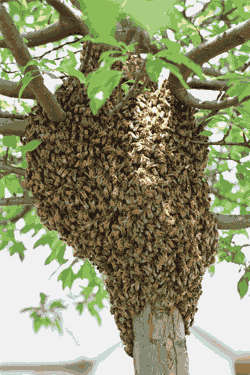 se sometimes the vibration and noise of the mower will set these bees and other stinging insects off.... One job was on a playground of a school in a tree about 40 feet up and consisted of over 40,000 bees. So please be carful when doing outside activities and if you are allergic please have a Epi-pen available...... It could save your life...
Subscribe to:
Posts (Atom)
